

The 80/20 rule reveals why focusing on your top accounts delivers exponential returns—and how to apply it to your sales strategy
Coverage. Volume. Numbers. MORE!
These are the words we hear constantly in sales discussions. But where should you actually put your time, effort, and focus to accomplish these goals?
Thanks for reading! Subscribe for free to receive new posts and support my work.
Subscribe
I’m going to share an approach that’s been around for decades—but with a fresh perspective that might help you redirect your focus, or the focus of those who report to you.
Start With the End in Mind
If I wanted to be the top salesperson in my company, I’d work backwards from success. Here’s how:
- Study the winners – Find out who has sold the most in the past
- Verify the opportunity – Confirm there are enough prospects/customers to reach that goal
- Create a strategic plan – Map out how to accomplish the goal
- Optimize for efficiency – Achieve it with the least amount of time and effort
The secret? It’s not working harder—it’s working smarter by understanding where your real opportunities live.
The Power of the Inverse Relationship
Years ago, a wise mentor showed me something that changed everything: when you break down all prospects in your territory based on their potential and organize them into four groups, a clear pattern emerges.
Here’s what it looks like:
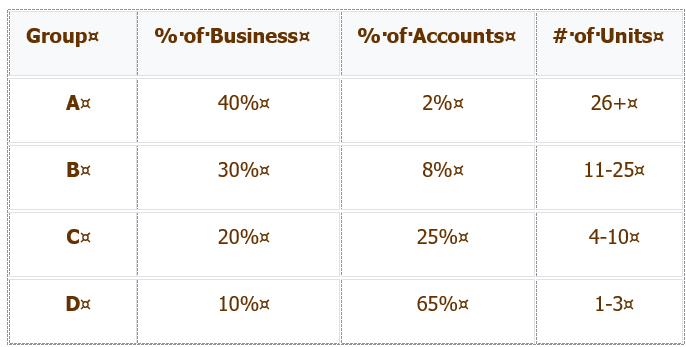
Look at that inverse relationship.
The top 40% of your business comes from just 1-5% of your accounts. These are your volume accounts—they don’t just buy more equipment, they consume more parts and service to maintain that equipment.
The 30% potential group? Larger number of accounts, but still substantial per-account volume.
And so on down the line.
The bottom 65% of your accounts represent only 10% of your business.
Where Should You Focus Your Time?
![Visual representation: Most business is concentrated in A & B accounts—the large users of your product]
The math is clear: if 10% of your accounts represent 70% of your business, shouldn’t 70% of your time go there?
Yet most salespeople spend their time evenly distributed across all accounts—or worse, they spend disproportionate time on the smallest accounts because they’re easier to reach or more demanding.
Make the Shift
This isn’t about ignoring smaller accounts. It’s about intentional allocation of your most valuable resource: time.
- A Accounts (40% of business, 2% of accounts) – Deserve frequent contact, relationship building, strategic planning sessions
- B Accounts (30% of business, 8% of accounts) – Regular check-ins, proactive service, growth opportunities
- C Accounts (20% of business, 25% of accounts) – Periodic touchpoints, efficient service delivery
- D Accounts (10% of business, 65% of accounts) – Self-service options, automated communications, group events
The goal isn’t to provide poor service to D accounts—it’s to provide appropriate service to each tier while investing your personal time where it creates the most value.
Your Action Plan
- Segment your territory using the four-tier system above
- Audit your time for the past month—where did you actually spend it?
- Reallocate intentionally to match your time investment with revenue potential
- Measure results quarterly and adjust
Want to be the top salesperson? Put your time where you’ll get results.
Thanks for reading! Subscribe for free to receive new posts and support my work.
Subscribe
Comments (0)
Leave a Comment
No comments yet. Be the first to comment!